The saw is the first investment in an aluminium or PVC workshop, and it sets the quality of every other operation: a wrongly cut profile cannot be fixed at assembly. The choice does not depend on “the biggest machine”, but on what you build, in what series and from which profiles. The guide below helps you decide, using data from the LGF datasheets.
Single head or double head?
A single-head saw cuts one end of the profile per cycle. The angle is changed by tilting the head (on Sirio, for example, the pneumatic tilt is indexed at −45° / 90° / +45°, with intermediate angles on a mechanical stop). It is the solution for small workshops, for varied jobs and for cuts at varied angles. The compact versions take little room: Venus weighs 330 kg and Astra A / Astra M, with upward cutting, only 120 kg.
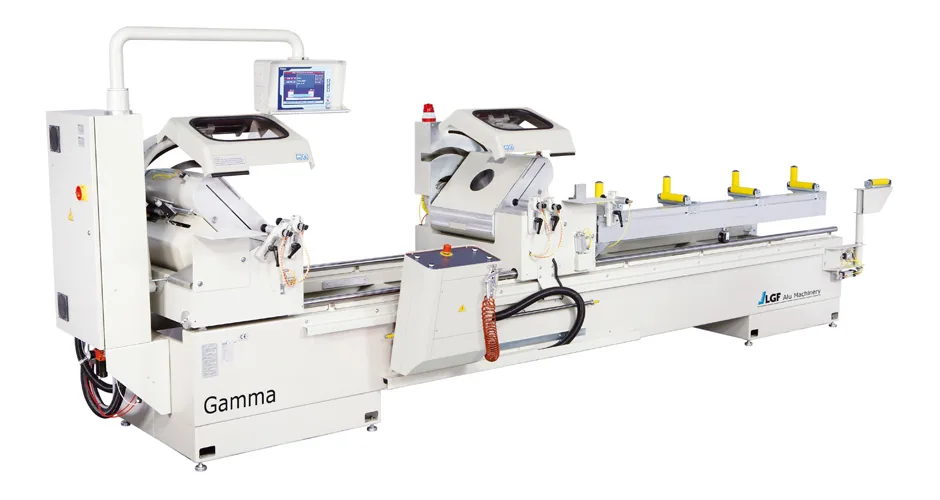
A double-head saw cuts both ends of the profile in the same cycle, with one fixed and one moving head, so it produces series of windows and doors with repeated dimensions faster. Gamma Digit has pneumatic head tilt at 90° / +45° and cuts bars up to 4, 5 or 6 m; Delta Digit is the compact version, with blades of up to 400 mm. If you cut dozens of profiles every day at the same angles, two heads pay off quickly; if you work less often or in small batches, one head is usually enough. See all the single-head saws and the double-head saws.
Manual, semi-automatic or electronic
On semi-automatic models (MX) the moving head is moved with the handwheel and the dimension is read on a precision graduated scale; Gamma MX has micrometric dimension adjustment. They are sturdy, simple and suitable when dimensions change often and you do not need cutting lists.
On electronic models (Digit) the moving head is moved by an electronic positioner. Gamma Digit has a 10″ colour touch screen and a USB input for reading and saving cutting lists. Delta Digit has a monochrome display and integrated keypad, also with a USB port. The electronic version removes dimension reading errors and makes batches repeatable, but costs more than the semi-automatic one.
Go further with Gamma Digit Plus and Gamma Swing Digit Plus, with 3 controlled axes: the head tilt is motorised, so you set any angle, not only the indexed ones.
What matters on the datasheet
- Blade diameter. The blade sets the maximum cutting height. Gamma Digit has Ø 500 / 530 / 550 mm blades, while Delta Digit and Argo work with blades of up to 400 mm, for smaller profiles. For wide profiles there is Hydra Digit (Ø 500–530 mm blades), where the cutting dimension stays exact whatever the profile height.
- Angles. Check which angles you use: 90° and 45° are on all of them, while for −45° you need a “Swing” version (for example Gamma Swing Digit), which tilts the heads both ways. Special cuts are made on Urania, with 550 mm blades.
- Working length. Gamma Digit is available for maximum cutting lengths of 4,000 / 5,000 / 6,000 mm, Delta Digit for 4,000 / 5,000 mm and Argo for 4,000 mm. Choose by the longest bar you cut, not the average one.
- Floor space and air. The saws above work at 7 bar. Also check the footprint: a double-head machine for 6 m bars is over 7 m long, so you need room for it and for the bar to be loaded.
Matching the model to the workshop
- Small workshop, varied jobs: a semi-automatic single-head saw, for example Sirio or Venus.
- Series of aluminium windows and doors: a semi-automatic (Gamma MX) or electronic (Gamma Digit) double-head saw.
- Numerically controlled angles on one head: Sirio Digit, with motorised tilt from −22.5° to +22.5° at any intermediate value.
- Wide profiles or special cuts: Hydra Digit, Vega or Urania.
What to add next to the saw
A saw only works at capacity if the profile arrives quickly and at the right dimension. That is why you complete it with a measuring conveyor: Digirol has a programmable motorised stop that stores up to 99 lengths, while Visirol and Toprol have a stop moved by hand with a handwheel. Aluminium swarf is collected with an industrial extractor. If you need a machine for a special type of cut, see also the glazing bead saws and the corner cleat saws.
Safety, motors and power supply
Most double-head saws in the range have the blades protected by automatically closing guards, and the motors are three-phase: Gamma Digit has 2.2 kW (3 HP) motors, while Delta Digit and Argo have 1.5 kW (2 HP). On single-head models the guard differs: Venus has a manually closing guard, like Astra A / Astra M in the CE version. Check from the datasheet which electrical supply you have in the workshop before choosing, because three-phase motors need a suitable network.
Also check the blade feed. On several models the blade feed is radial (for example Gamma Digit or Sirio), and on others the blade exit is adjusted with an external hydro-pneumatic brake (Sirio, Argo). These details show on the datasheet, which is why it is worth downloading before you ask for a quote.
Common mistakes when choosing
- Choosing by the biggest machine, not by the real length of the bars you cut.
- Forgetting wide profiles or special angles, which you discover only after buying.
- Leaving out the measuring conveyor and the extractor, although without them the saw does not work at capacity.
- Comparing only electronic versus manual, without looking at the jobs you do most often.
How to ask for a quote
Tell us which profiles you cut, how long the longest ones are, which angles you use and how many pieces you cut per day. With this we recommend two or three models, not the whole range. You can tick the models you are interested in directly on the quote request form or call us at +40 712 641 983. For the rest of the workshop, read also the guide on equipping an aluminium window workshop.