An aluminium window workshop is not equipped all at once. You can start with four machines and add others as volume grows. Below is the list, in three stages: small workshop, growing workshop and complete line. The models are examples from the LGF range; what you choose depends on the profiles and series you produce.
The basic operations
Every aluminium window and door workshop has the same operations: cutting the profiles, machining (holes and routing for locks and handles), assembling the corners and clearing the swarf. Special machining (milling the ends of mullions and transoms, bending, notching) is added according to the type of work.
Stage 1: small workshop
- Cutting: a single-head saw, for example Sirio or Venus (330 kg). See the single-head saws.
- Machining: a manual copy router, Tiger M, or the portable Trac (40 kg). See the copy routers.
- Assembly: a corner crimping machine, for example Scriba (270 kg), with a stamping force of 3,500 kgf. See the corner crimping machines.
- Swarf extraction: an extractor, Ultra (50 l tank) or Spiro (120 l). See the industrial extractors.
Stage 2: growing workshop
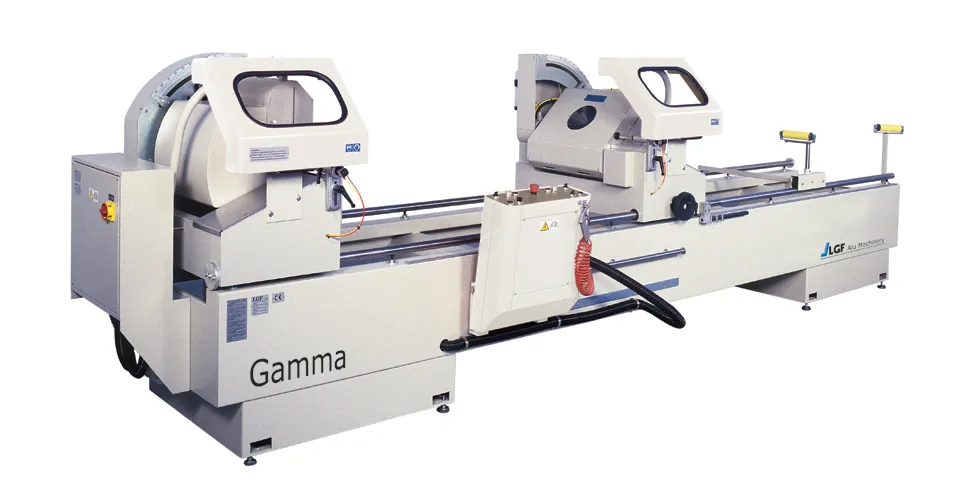
When you have more orders, cutting becomes the busiest operation. Move to a double-head saw, for example Gamma MX (semi-automatic, bars up to 6 m) or Delta MX (compact), and complete it with measuring conveyors: Serol on the loading side, Toprol or Visirol on the unloading side.
- Machining: Tiger SA, a semi-automatic numerically controlled copy router with a 10″ touch screen and X and Y axes controlled by joystick, which saves programs and runs them one after another.
- Ends of mullions and transoms: if you build façades or partitions, an end milling machine, for example Derna or Star M / Star A. See the end milling machines.
- Assembly: Hermes, pneumatic, with two pneumatic vices.
Stage 3: complete line
At high volume, cutting becomes electronic and machining moves to CNC centres. You can choose Gamma Digit (10″ touch screen, USB for cutting lists) or Hydra Digit for wide profiles, together with Digirol, the conveyor with programmable stop that stores up to 99 lengths. For machining, Phoenix (profiles of 2.5–4 m) or Orion (profiles of up to 7 m) run the holes and routing automatically. See also the guide on CNC centre or copy router.
- Drainage: Bora mills the drainage slots, with 1, 2 or 3 working units. See the drainage slot milling machines.
- Curved joinery: Roll bends aluminium profiles and steel tubes, and Ronda Digit mills the rounded ends.
- Curtain walls: Alfa and Alfa 55, notching machines. See the curtain wall notching machines.
- Glazing beads: Beta and Bifra. See the glazing bead saws.
What not to forget besides the machines
- Compressed air. The datasheets show 7 bar for the pneumatic machines: you need a compressor and a suitable installation.
- Electrical supply. The motors of the saws are three-phase (for example 2.2 kW on Gamma Digit), as is Ultra; Spiro has a 2.2 kW single-phase motor. Check the network in your workshop.
- Space. A double-head saw for 6 m bars is over 7 m long, and Orion is 590–890 cm. Also plan room for bars and for the cut profiles.
- Safety guards. On Orion, the perimeter guard is available on request and is mandatory in the European Union, so also in Romania.
- Tools and consumables. Blades, cutters and vices wear out and are replaced: include them in the budget from the start.
How to move from one stage to the next
The machines from stage 1 are not thrown away at stage 2. The single-head saw stays useful for special cuts or small orders, even if you now have a double-head saw, and the manual router can complement a Tiger SA or a CNC centre for rare jobs. The extractor and crimping machine usually move with the workshop; you just add a second machine when a single one becomes a bottleneck.
A simple criterion: when one operation keeps the rest of the workshop waiting, it is the next one to upgrade. Note for two weeks how long each stage waits and you have the priority list.
Three set-ups, in brief
- Small workshop: Sirio, Tiger M, Scriba and Spiro. It covers cutting, machining, assembly and swarf.
- Growing workshop: Gamma MX with Serol and Toprol, Tiger SA, Hermes and Ultra.
- Complete line: Gamma Digit with Digirol, Orion or Phoenix, Hermes, Bora and Ultra.
These are only starting points. Tell us which profiles you use and what you build and we adjust the list: for example, a workshop that makes only doors can drop some machines, while one that makes façades adds the curtain wall machines and end milling. Every model has its own page, with technical specifications, standard equipment, what can be ordered on request and the PDF datasheet to download, so you can compare before asking for a quote.
How to order your investments
Start with the operation that slows you down most. In most workshops that is cutting, then machining and, last, automation. Do not forget compressed air (the datasheets show 7 bar for the pneumatic machines) and room for long bars. For details on cutting, read how to choose a cutting saw. All the models are in the A–Z list of LGF machines.
Tell us what you build and in what series, and we suggest a list suited to your workshop, from a single machine to a complete line. On the quote form you can tick several categories at once.