When profiles must be drilled and routed for locks, handles, hinges or drainage, you have two families of LGF machines: copy routers and CNC machining centres. The difference is not only price, but capacity, the way you change the tool and the floor space you have. The guide compares the two options using the datasheets.
What a copy router is and what a CNC centre is
A copy router is a compact machine with one head (or two, on Duplex), on which you clamp the profile in vices and rout in several positions. It can be manual (Tiger M), semi-automatic with numerical control (Tiger SA) or numerically controlled (Tiger CNC, Junior CNC). See the whole category of copy routers.
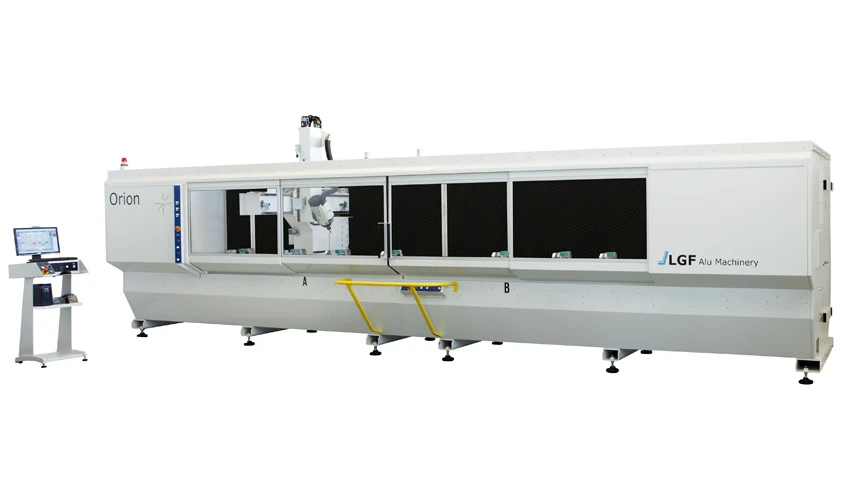
A CNC machining centre works on 4 controlled axes, with an electro-spindle, adjustable vices and an automatic tool magazine. Orion and Phoenix are the LGF centres for long profiles. See also the CNC machining centres.
Comparison from the datasheets
- Profile length. Tiger CNC has a working capacity of 470 mm in length; Junior CNC, 2,550 mm; Phoenix, strokes of 2,500 / 3,000 / 4,000 mm; Orion, 4,000 / 7,000 mm. CNC centres can also machine parts longer than the machine.
- Tooling. Tiger CNC uses an ER 25 collet and manual tool change. Phoenix has an automatic 7-tool magazine and Orion a 5-position one, with automatic change.
- Accuracy. Tiger CNC, Junior CNC, Phoenix and Orion have a tolerance of ±0.2 mm.
- Space and weight. Tiger SA has a footprint of 115 × 135 × 186 cm and 321 kg; Orion is 590–890 cm long and weighs 2,200 / 3,775 kg. These models work at 7 bar, so you need a compressor.
- Programs. On Tiger SA and Tiger CNC you can queue several programs and the machine runs them one after another; programs are saved and loaded through USB.
When a copy router is enough
A copy router is the right choice if you machine profiles of ordinary length for doors and windows, if the volume is small or medium and if you want to start without a large space. Tiger M is manual, with a pneumatic rotary table at 0° and −90°, and recommended for aluminium, light alloys, PVC and steel and stainless steel tubes. If you need a machine that is easy to transport, there is Trac, portable, 40 kg. For PVC, Apis M / Apis A has a horizontal drilling unit, and Tracer works at 14,000 rpm.
When to move to a CNC centre
Move to a CNC centre when profiles are long (for example façades or large doors), when you produce in series and when you want the same program executed identically every time, without manual tool change. Phoenix rotates the part at 90° / 0° / −90°; Orion rotates the electro-spindle from 0° to 180°, so you can machine several faces of the profile without moving it. On Orion, the perimeter safety guard is available on request and is mandatory in the European Union, so also in Romania.
Which jobs you do most often
- Locks and handles on ordinary profiles: a copy router, for example Tracer or Tiger M.
- Machining on 4 sides without moving the profile: Duplex, with two heads and independent motors.
- PVC profiles: Apis M / Apis A, with a vertical head and a motorised horizontal drilling unit.
- Holes, routing and slots on long profiles, in series: Phoenix or Orion.
- Work on site or in narrow spaces: Trac, portable, 40 kg.
Programming and operation
On Tiger SA you work from a 10″ touch screen and a console with two joysticks for the X and Y axes, and the LGF software is intuitive and macro-based. Tiger CNC has a programmer with a colour touch screen, a USB port and can run several programs one after another. The Phoenix and Orion centres are controlled from a PC with dedicated LGF software and a Windows interface. On Orion the vices move automatically, under control, and on Phoenix the position of the vices is detected by a photocell.
Also think about who operates the machine. A manual router is learned quickly, but depends on the operator’s skill; a numerically controlled machine runs the saved program identically every time. If you change the job often, saved programs make the difference.
Three typical situations
- Small workshop, a few jobs per day: Tiger M or Tiger SA are usually enough and take little room.
- Workshop that produces series of doors and windows and wants repeatability: Tiger CNC or Junior CNC, with numerical control and ±0.2 mm tolerance.
- Façades or long profiles, high volume: Phoenix or Orion, with an automatic tool magazine.
Cooling, lubrication and tooling
On aluminium, coolant and lubrication matter for tool life. Tiger CNC sprays coolant automatically onto the tool, while Orion has automatic timed spray lubrication. The routers use the ER 25 collet (on Tiger CNC with manual tool change), while the CNC centres use ISO 30 holders and an automatic tool magazine: 5 positions on Orion, 7 on Phoenix. Extra holders and collets can be ordered on request, so tell us which tools you use when you ask for a quote.
Keep in mind that these machines work on aluminium, light alloys and PVC, and the routers also on steel and stainless steel tubes, according to the datasheets. For other materials, ask us before you choose.
What to ask before choosing
- How long is the longest profile I machine?
- How many pieces do I machine per day and how often do I change the program?
- What materials do I use (aluminium, PVC, steel or stainless steel tubes)?
- How much space and what air supply do I have in the workshop?
- Who will program the machine and how much time do they want to spend on it?
If you are not sure, call us at +40 712 641 983 or send a request on the quote page, with the profiles you machine. See also the machine list for a complete workshop and the guide to choosing a saw.